Evolium Labs

Research that informs how we build.

Evolium Labs is where we test how intelligent systems should read, evaluate, and decide — before those ideas reach a client's operation.

  1. Start from a real question

    Research begins with a problem someone actually has.

  2. Report evidence with its limits

    Results come with what they don't show: imbalance, sample size, generalization.

  3. Keep provenance exact

    Where work originated is stated plainly, without overstatement.

01Current applied research · 2026

Self-validating extraction from heterogeneous bank statements

QuestionHow should an AI system read financial documents when formats vary by bank, periods are ambiguous, and a wrong guess reaches a real application?

In mortgage operations, bank statements and income documents arrive in inconsistent layouts, often before the case requirements are known. Extraction is paired with a reconciliation pass that decides which requirement each document satisfies — and when a person has to decide instead.

Approach

  1. Two passes: understand the document first, reconcile it against requirements once the case profile exists
  2. One physical file may satisfy several monthly requirements, each with its own evidence and confidence
  3. Weaker evidence (a payment date instead of a statement period) is explicitly discounted
  4. Every unplaced document raises a visible notice for an adviser

Finding

The system is built around three refusals: it never invents a period, never overrides a human assignment, and never silently drops a file.

Now informing

Governed AI is designed as much around what the system must not do as around what it automates.

ActiveEvolium applied research, applied in current client work.

02Research foundations · 2025

Geometry-aware deep learning for 3D LiDAR plant-organ segmentation

QuestionCan a model separate stem, leaf, and support structures in raw 3D scans well enough to support biomass estimation?

A Dynamic Edge Convolutional Neural Network segmented LiDAR point clouds of plants into organs. Hand-engineered geometric descriptors were added so the model could reason about shape, not only position.

LiDAR point cloud of a plant, colored by predicted organ class: stem, leaf, and support stake
Model output: points colored by predicted organ class.
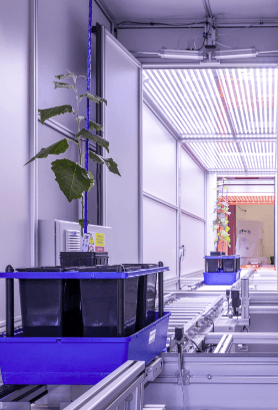
Plant phenotyping facility used for prior LiDAR research
Advanced Plant Phenotyping Laboratory, Oak Ridge National Laboratory.
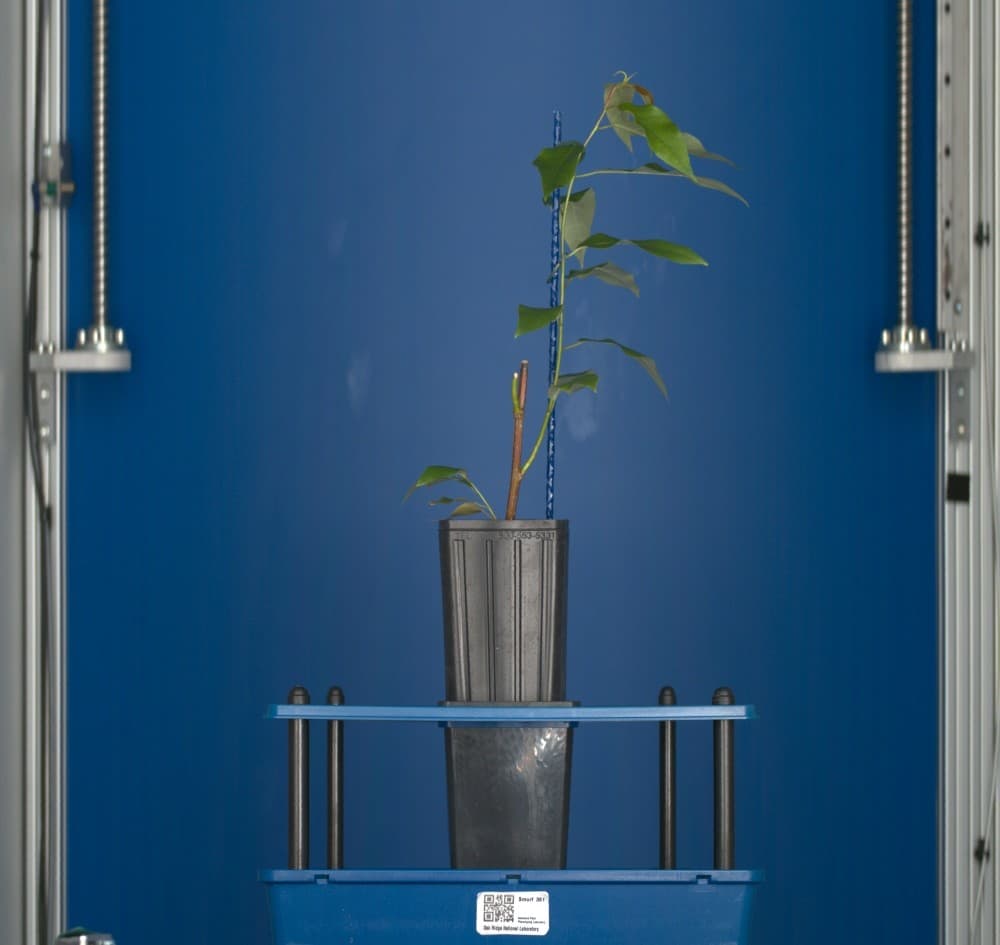
Three-dimensional LiDAR scan used for plant-organ segmentation research
A plant positioned for 3D LiDAR scanning.

Approach

  1. Reproducible pipeline for raw scans: background filtering, 2 cm voxel sampling, normalization
  2. Geometric features — linearity, planarity, sphericity, relative height, surface normals
  3. Manual annotation protocol producing 30 fully segmented scans
  4. Evaluation by per-class IoU and recall under severe class imbalance

Finding

Global mean IoU of 65.58% and stem recall of 82.27%. The stem is the organ that matters most for biomass, so the evaluation was designed around that decision rather than a single headline score.

Now informing

Evaluate against the decision the system supports, not the metric that looks best.

OriginResearch foundation developed at East Tennessee State University, with collaboration from Oak Ridge National Laboratory, and now informing Evolium Labs.

03Research foundations · 2025

EEG motor-intention classification and generalization

QuestionCan rest, left-hand, and right-hand motor intentions be classified reliably from noisy, non-invasive EEG signals?

Traditional pipelines — Common Spatial Patterns with linear classifiers and PCA — were compared against a one-dimensional convolutional network learning directly from minimally processed signals.

Approach

  1. Band-pass filtering and time-, frequency-, and spatial-domain feature engineering
  2. Explicit handling of class imbalance before model comparison
  3. Classical baselines compared against a 1D CNN on held-out data
  4. Attention to low signal-to-noise ratio and variation between individuals

Finding

Accuracy on a held-out split is not the same as generalization. Inter-subject variability defines how far a result can responsibly be trusted.

Now informing

Before intelligence enters an operation, test whether it holds beyond the data it was built on.

OriginResearch foundation developed at East Tennessee State University, and now informing Evolium Labs.

Have a problem that needs research before it needs software?

Some operational problems start with an open question. We can help frame it, test it, and decide what is worth building.

Discuss a problem